

11 December, 2025
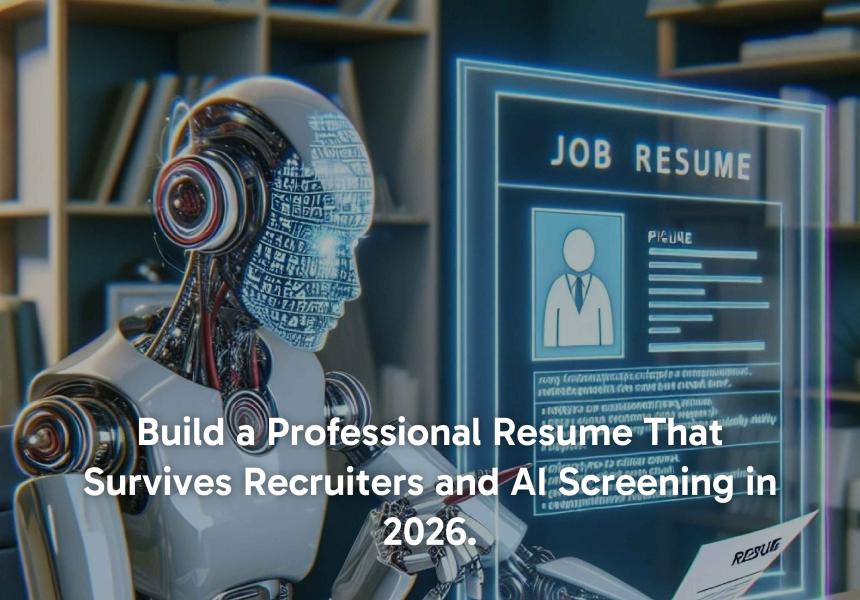
Build a Professional Resume That Survives Recruiters and AI Screening in 2026
Somewhere around 2024–2025, hiring went from “send a resume and hope” to “fight your way through a recruiter and an algorithm.” And honestly… Most people weren’t ready for that shift.Now we are in the year 2026, and resumes appear to be plain on the surface but very technical on the inside. Recruiters are scanning resumes at lightning speed. ATS systems are filtering out applicants even more rigorously than before. And job seekers?
They’re stuck trying to make a professional resume that feels human but still survives the screening bots.
The good news? You don’t need anything complicated. You just need a resume that’s clean, readable, and doesn’t confuse the system before a real person even opens it. So this way, your chance of getting hired in your desired company stays intact.
Let’s take a brief look at what it needs to create a professional resume that beats human recruiters and AI.
Why Professional Resumes Keep Getting Rejected (Even Good Ones)
People assume their resume isn’t strong enough. Sometimes that’s true. But a lot of rejections happen because:
1. The format is extremely disordered
2. The ATS cannot interpret columns or icons
3. The name of the document appears disordered
4. The keywords of the job description are not found anywhere
5. The summary communicates, but does not convey anything
And here is the point which no one vocalises: ATS machines do not "dislike" you. They are simply rigid. If your resume is not organized in a manner they comprehend, they overlook it.
Our detailed blog on how to write a resume on AI Pro Resume explains, and it’s blunt but accurate that clean layouts work better than “creative” ones.
How Recruiters Actually Read Resumes Now
Most do a fast scan. More like: header → current job → skills → done. If anything looks confusing, they move on. When they encounter something that lacks clarity, they just pass. If your professionalism is wrapped in a difficult-to-understand design, they just skip your resume without a second thought.
A professional resume in 2026 has one job: Stay readable long enough for a human to decide you’re worth a callback.
The Core Resume Structure That Still Works (and hasn’t changed much)
This is the structure that practically always gets through the initial filtering:
1. Simple header: name, email, phone, city
2. Short summary: 2–3 lines that show what you do and who you help
3. Experience: bullet points, not paragraphs
4. Skills: relevant, not random
5. Education: simple, no decoration
6. Optional add-ons: certifications, tools, achievements
That’s it. This is all the information recruiters need, presented cleanly.
Let’s Break Down the Parts Without Overthinking Them
1. The Summary
Keep it small. Think of it as your elevator pitch. Short and meaningful.
✅Good summary: “Digital marketer with 4+ years growing early-stage startups. Focus on SEO, content strategy, and quick experimentation.”
❌Bad summary: “A driven, passionate, enthusiastic individual seeking opportunities to leverage my diverse skills for organizational excellence.”
A vague summary will make the recruiter skip your resume without reading it further.
2. Your Bullet Points Need to Sound Like You Worked, Not Floated Around
There’s no need for you to brag. Just tell what you have accomplished. A pattern that is helpful (not too AI-like, do not worry):
Action → what you did → why it mattered
Example:
“Redesigned onboarding emails, helping increase activation by roughly 20% over three months.”
Short. Real. Humans. Make sure your experience is crisp and concrete by quantifying it like the example above.
3. Skills Section: Stop Listing Everything You’ve Ever Touched
Recruiters are able to recognize the difference between “expert” and “once tried during a bootcamp.” Instead of a big skill cluster, do this:
1. Tools you actually use well
2. Skills relevant to the job
3. Remove anything outdated
Sometimes a clean resume is just one that is not packed with filler.
4. Resume Formatting Matters More Than Most People Think
There are studies that show resumes get rejected for things like:
1. Two columns that the ATS scrambled
2. Icons replacing words (“☎️” instead of “Phone”)
3. PDFs exported incorrectly
4. Dates written in different formats
A job-ready CV looks simple, almost dull. But that “boring” layout… is exactly what the AI can read. If you don’t want to deal with layouts manually, AI Pro Resume’s resume templates and resume examples, along with cover letter examples, help because they’re already ATS-tested. Just fill in your info.
Why You Need to Write for Recruiters and Algorithms
ATS systems scan for keywords first. Humans scan for clarity second. You need both. Think of it like this:
1. The ATS decides, “Should this resume be seen at all?”
2. The recruiter decides, “Should I interview this person?”
That’s why people talk about ATS-friendly resumes so much. It doesn’t mean “write like a robot.” It means “don’t hide the important stuff.”
Recruiters Say They Want ‘Personality’ (But Only the Useful Kind)
Unless hobbies relate to the job or demonstrate reliability, no one is interested in them. A good way to add personality without slipping into fluff:
1. Talk about your favourite tools
2. List accomplishments
3. Use numbers where appropriate
4. Bullet points instead of paragraphs
Humans like clarity. AI likes structure, and both like facts.
A Quick Section for People Who Hate Writing Resumes
This is normal. Most people say: “I can talk about my work fine… but resume writing feels awful.” That’s because writing about yourself makes you feel like you are boasting about yourself. A 2022 study by LinkedIn found that 63% of professionals struggle most with “selling themselves” on paper.
Tools like AI Pro Resume’s CV builder can help you draft faster without making the resume sound robotic. You still control the tone; it just helps with structure and small tweaks.
A Few Things You Should Definitely Avoid
You just need to skip these:
1. Skill bars (ATS can’t read them)
2. Big images
3. Flowery “I am passionate…” openings
4. Thick paragraphs
5. PDFs created from screenshots
6. Random quotes
When to Use Templates
Amazingly, some people still believe that templates make you look unoriginal. This is not true. It is only bad templates that make you look that way. The good one gives you:
1. spacing that makes sense
2. a proper resume format
3. consistent fonts
4. ATS-safe structure
With AI Pro Resume, your whole application looks aligned without you sweating over design choices because it has cover letter templates, ATS checker tools, and matching free resume templates.
Common Mistakes That Cost Interviews (Even for Great Candidates)
You’d be surprised how often these show up:
1. Writing like you’re talking to your old boss
2. Listing responsibilities instead of results
3. Using buzzwords without examples
4. Forgetting to match keywords from the job posting
5. Not updating older jobs
6. Overstyling the document
If your resume feels “busy,” it won’t pass the test.
Wrapping Up
A professional resume is not necessarily perfect in grammar or nice layouts. It has to be nothing but clear, well-structured, and showing your mastery of the field. Moreover, since both humans and AI are screening applications, the “clear and simple” comes out to be the winner over “creative and complicated” most of the time.
Combine a strong resume with neat resume formatting, actual numbers, and essential words, and you’ll get more visibility. Not necessarily hired, that's something no one can guarantee, but certainly noticed. And to be honest? That is the hardest part for most people.
Frequently Asked Questions (FAQs)
How should a resume look in 2026?
A resume and job application letter in 2026 don’t need anything fancy. Keep the page clean, give the layout some space, and focus on the work you’ve actually done. Most hiring teams still prefer simple fonts, a single column, and headings they can spot fast. ATS tools read that format easily, which helps you stay in the mix. What matters most now is real results, clear actions, useful keywords, and not too much fluff. If everything fits on one solid page, that usually works best.
What is the CV style for 2025?
Your answer to how to write a CV, specifically if we talk about the style, is simple. The style that is always prominent is the minimalist one. It includes clear spacing, simple fonts such as Calibri or Arial, and headings that are very visible. The reverse-chronological order is still the most popular way, but career changers sometimes go for a hybrid approach to emphasize skills.
What is the 7 second rule in a resume?
It’s basically the idea that a recruiter would give your resume just a few seconds during the first round of reviews, about seven seconds. In that very short time, they are looking for your job title, recent experience, and anything that fits their needs right away. If the resume seems to be cluttered or not very clear, they will go on. If it is clean and relevant, they will read it further. The process is fast, but that’s how most screening is done nowadays.
How long can a resume be in 2025?
For the majority of individuals, a single page continues to be the safest option. If you have gained some experience or if you belong to a technical domain, then two pages are quite standard. More than that is typically acceptable only for high-level managers, researchers, or government positions where additional detail is required as part of the process. The best resume tips are very straightforward: let it be as long as it is necessary, but do not prolong it just to occupy space.
Related Posts



27 Jan, 2026

