

29 December, 2025
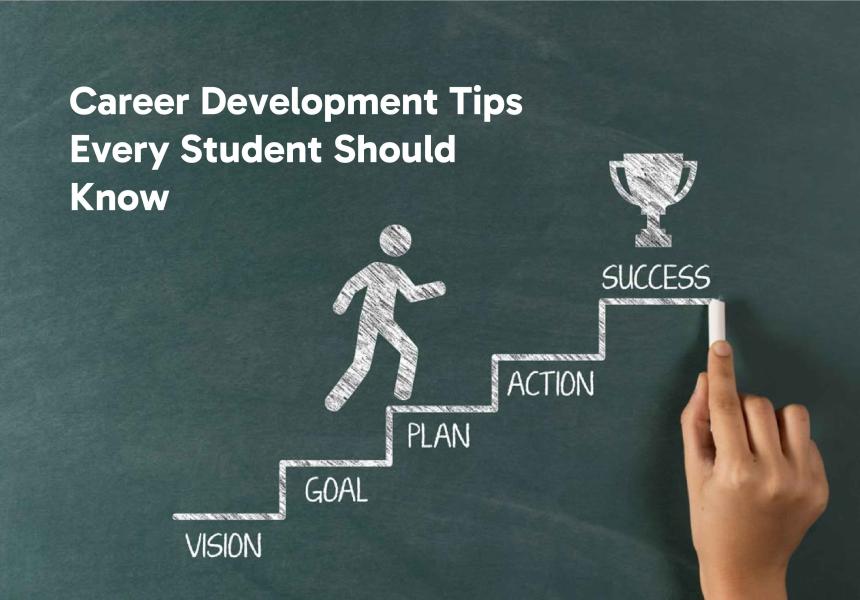
Career Development Tips Every Student Should Know
Let's be truthful. The term "career development for students" can sound like a bulky textbook. Something you ought to do, but it's all so unclear. It sounds like five-year plans, flowcharts, and tense counseling sessions.What if we made all the mistakes?
Having a flawless plan is not the goal of true career growth for students. It's about learning how to build things on foot. Equipment assembly is just as important as choosing a location.
Understand this in a way. You wouldn't attempt to build a house using the blueprint alone. You would first learn how to measure wood, hammer nails, and mix concrete. Career planning for students works the same way. The doing is where the "plan" originates.
One genuine step at a time—this is how you construct it.
Ditch the "Final Goal." Focus on "Right Now" Career Projects.
Your aspirations for your career goals can paralyze you. It's okay to say, "I want to be a marketing director," but that doesn't tell you what to do on a Tuesday afternoon.
Instead, focus on projects. This is one of the most practical student career tips. What can you make or do right now that uses a skill you enjoy?
Love writing? Start a tiny blog about your hobby. Enjoy organizing things? Plan an event for your club. Fascinated by data? Analyze the results of a class project and present them in a new way.
These projects are your real skill development for students. They give you concrete things to talk about. They answer the dreaded "What experience do you have?" question with proof, not just a claim. They are the absolute best way to learn how to build a resume with no experience. You're not waiting for permission. You're creating the experience yourself.
Talk to Real People, Not Just Job Boards.
Here’s a secret nobody tells you: most opportunities are hidden. They never get posted to a job board. They live in conversations.
Your student career planning should involve way more talking and way less scrolling. Interview a person whose profession seems interesting.
A simple message works:
Hello, I am a student, and I was very impressed with the job that your company did on [specific project]. is the message that shows. I would like to understand how you got started. Could we have fifteen minutes of conversation?
This isn't networking. This is curiosity. You’ll learn about real entry-level opportunities and graduate trainee programs you never knew existed. You’ll get job search tips for new graduates that never appear online.
Get Hands-On Experience Early (Even Small or Unpaid Work)
Yes, paid internships matter. You should always aim for paid work. But let’s be honest.
Sometimes, getting in the door is more valuable at the start. A short project. A few hours a week helping a local business. These are not failures. They are practical career-building steps for students.
You also get to see how work actually happens, not how it’s described.
If possible, consider an internship abroad. It’s more than a CV line. It teaches adaptability.
Your job search is a skill. Practice it.
Searching for jobs after graduation is its own project. You have to practice it.
Start with your resume. Don’t just list job titles. Tell short stories.
1. "Trained 3 new team members" shows leadership
2. "Managed weekly inventory" shows organization
Use clean resume templates and review resume examples for students to understand structure. Then run it through an ATS checker. This step is no longer optional. If software can’t read your resume, a human never will.
Your cover letter is your voice. Use cover letter templates to get the structure right, then make it personal. Explain why you, why this role, and why now.
The One Mindset Shift That Changes Career Development
All this boils down to one change. Stop thinking of your career as something you find. Start thinking of it as something you build.
You are the builder. Every project is a brick. Every conversation is a window. Every skill you practice is a solid piece of flooring.
You won't get every block at first. It is okay. You only need to start putting them one at a time. As you construct the path, it appears.
So disregard the intimidating ten-year plan. "What is one small, useful thing I can build or learn this month?" is an easier question to ask yourself.
Do that. Then do the next thing. That’s career development. It’s not a plan you follow. It’s a person you become, one small, smart step at a time. You’ve got this. Now go build something.
Conclusion
Career development for students is more than just passing an exam. It's a habit. It's the little, regular decisions you make, like the task you begin, the discussion you have, or the ability you attempt. Don't wait for the ideal strategy to emerge. One genuine, human step at a time, begin constructing your path now. Your future career is created, not discovered. You are the builder, too.
Frequently Asked Questions (FAQ’s)
What can I do to prepare myself to join the workforce before graduation?
As a way of gaining practical experience, join clubs, work part-time, or engage in personal projects.
And what happens when the jobs that I desire do not match my degree?
Do not just focus on what your big title is but on the skills you developed.
What is the importance of grades in a career?
They matter for certain first jobs, but in the long term, experience plays a greater role.
Is it worthwhile to pursue one career or focus on one?
You can never be sure of what you like unless you sample a few things; hence, the need to explore early.
What should I do first today?
Find someone who seems to have an exciting career and ask him or her about it.
Related Posts




27 Jan, 2026

