

08 December, 2025
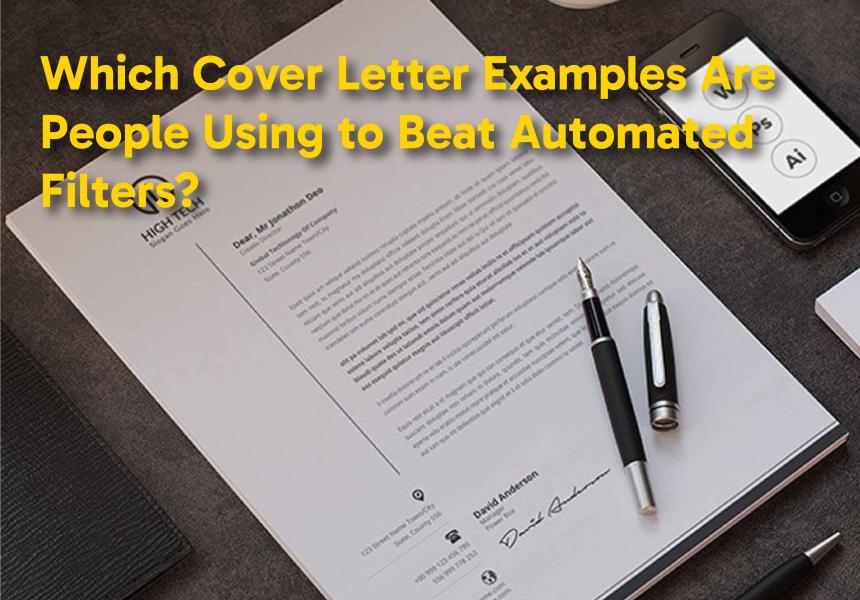
Which Cover Letter Examples Are People Using to Beat Automated Filters?
Trying to write a cover letter felt complicated even before AI tools showed up everywhere. Now it’s a different kind of strange. On one side, you’ve got applicants letting AI write the whole thing. On the other side, you’ve got hiring teams using AI to scan the letters. And somewhere in the middle, real people are just trying to sound like… well, real people.That’s the part nobody talks about enough. You can spot an over-polished AI letter from a mile away. Recruiters can too. And because so many applications look the same now, the few letters that do feel personal end up standing out more than ever.
And that’s exactly why people keep searching for cover letter examples that actually make sense in the 2025 job market. Not the textbook ones. Not the copy-paste templates. The ones written in a tone that feels believable, like someone actually sat down and thought about the role.
If you’ve used job search engines like AI Job Orbit, you already know how quickly job postings fill up. There’s barely any time to overthink everything. A simple, honest, well-targeted cover letter works better than something that sounds like a brochure. So let’s break down what kind of cover letter is working now, and why some examples feel fresh while others just blend into the pile.
Why Cover Letters Have Changed So Much
Hiring teams have shifted the way they read applications. That’s partly because tools like ATS filters sift through formatting and keywords first. And also because recruiters say they receive way more similar-sounding letters than they did even two years ago.
It’s not that cover letters died. It’s just that the old style doesn’t fit the current market anymore. The letters that get attention now share a few qualities:
1. They sound like a real person wrote them.
2. They don’t repeat the entire resume.
3. They connect the applicant’s experience to the company’s problem.
4. They mention something specific about the role.
5. They don’t rely on generic lines like “I’m a motivated professional…”
You’ll see this pattern in a lot of modern cover letter examples, especially the ones featured on AI Pro Resume, a powerful CV builder. Those resume examples and cover letter examples keep things short and grounded. They show personality without being dramatic. And they’re written in a way that flows, not in a way that looks like it came straight from software.
The Types of Cover Letter Examples That Still Work Now
Instead of the old “paragraph-paragraph-paragraph” format, most strong letters follow a slightly loose structure. Not messy, just more real. Here are the types that tend to stand out:
1. The “Why This Role Makes Sense for Me” Letter
This version is common in areas such as tech, marketing, and in case the employer wants to hire a person with self-awareness. It’s pretty much the applicant saying, “I know the requirements of this job very well, and here are the ways that I have already been working for it.” It’s uncomplicated but quite powerful in a way.
2. The Short, Straightforward Letter
There are some companies that like it when communication is done quickly. When the situation is such that:
1. The job listing is to the point
2. The team is very occupied
3. The person in charge of recruitment personally reads the job application letters.
These letters get to the point fast and skip anything that sounds like filler.
3. The Story-Driven Letter (but not dramatic)
This one uses a short moment or small example from past work to show how the person thinks. Not a complete narrative. Merely a glimpse. Nonetheless, it is effective since AI has more difficulty in generating plausible details. For this reason, individualized cover letters have lately been experiencing greater success.
4. The Skills-to-Impact Letter
You’ll see many job application letter examples using this. It’s where someone says: “Here’s what I know how to do, and here’s what it actually accomplished.”
Recruiters like this because the link between skill and impact removes guesswork.
Why Companies Still Read Cover Letters (Even With AI Filters)
Recruiters in recent surveys said something interesting: A lot of candidates now submit a resume and skip the cover letter completely.
Because of that, the people who do include one often have a small advantage. Not a huge one, but enough to get noticed.
Absolutely, a personalized cover letter, no matter how compelling, cannot remedy a bad résumé. However, if both the résumé and the cover letter are good, then the letter merely provides the context that the résumé cannot.
This is the point where AI Pro Resume gives assistance. The users of the application make use of free resume templates, cover letter templates, and an ATS checker, all of which are not to take over the writing but rather to streamline the process. After the structure is neat and professional, it will be much easier to incorporate your personality.
So Which Cover Letter Examples Should You Actually Follow?
Let’s break them into more defined groups so you can select one according to your circumstances.
- If you’re applying in a competitive field:
Opt for a concise letter that emphasizes the impact, along with an example showing how your work has helped to fix the issue. You can expect recruiters to read very quickly, so provide them with something to remember.
- If you’re applying on job portals with high traffic:
Point out one or two things that caught your attention in the job posting. Most candidates overlook this aspect, asking for attention to detail.
AI Job Orbit applicants do this often because listings there refresh quickly, and specific references help your letter feel timely.
- If you're applying internationally:
Be mindful of the tone expected in that region. The European resumes look different from the American ones. A minor formatting issue can alter the perception.
A Few Cover Letter Tips That Still Work (Even With AI Everywhere)
Here’s the part that hasn’t changed at all:
1. Google lines must not be copied.
2. Don’t use phrases typical of big companies unless you speak like that.
3. Don’t narrate your entire professional resume.
4. Just keep one clear message instead of enumerating all your past experiences.
And the part that has changed:
1. Add one specific detail from the job posting.
2. Use a small proof point (a metric, outcome, or example).
3. Add a line that shows you didn’t use a standard template.
The goal isn’t perfect writing. It’s believable writing.
Why AI-Generated Letters Don’t Always Work (and How to Avoid That Look)
The funny thing is: AI isn’t bad. It just sounds too polished sometimes. Recruiters keep saying the same thing; they can spot the tone immediately.
The way around this isn’t to avoid tools. It’s to use them lightly. People often use AI Pro Resume’s generator to get a base structure, then rewrite the parts that need personality. This combination works way better than letting the tool do 100% of the job.
That’s also why their cover letter templates and examples section is useful. It gives starting points without forcing you into the same tone as everyone else.
A Quick Way to Test Whether Your Letter Sounds Human
Read it out loud. If it feels like something you’d never say in a real conversation, edit it.
Most applicants feel the pressure to sound “professional,” and then end up sounding nothing like themselves. A natural tone cuts through the noise way faster.
Final Thoughts
Assuming that all processes are automated is the scenario that most people envision when it comes to a job market that is dependent on AI. However, it is true that personality moments are valued more by hiring teams as automation becomes more prevalent.
This is the reason why certain cover letter examples are effective while others are not. It is not a matter of having perfect grammar or using dramatic lines. The issue is, rather, clarity, timing, and a voice that appears to be from a real applicant.
If you match your letter to the job, keep it simple, and follow a structure that fits your situation, you’ll already be ahead of most people applying through online job portals or top job boards.
And if you need templates, formatting, or a clean structure before you start resume writing, AI Pro Resume has enough tools, as well as resume tips, to help you get there without replacing your voice.
Frequently Asked Questions (FAQs)
What is an example of an AI cover letter?
A typical AI-written cover letter usually sounds very clean and a bit too perfect. Something like: “I’m excited to apply for the role at your company, and my background in machine learning makes me a strong fit.” Tools often build letters around lines like that. They follow a predictable pattern and lean on buzzwords, which is why they’re easy to spot if you don’t edit them afterward.
Do jobs check if your cover letter is AI?
Some do, some don’t, but hiring teams can usually tell when a letter feels fully generated. They look for odd phrases, a strange tone, or wording that doesn’t match the resume format. Many recruiters say they don’t mind if AI helped with the draft, but they mainly notice when nothing in the letter sounds personal or specific to the job.
What AI can make a cover letter?
Plenty of tools can create a first draft. Grammarly is one of the popular ones because it adjusts tone and length pretty quickly. Others do the same thing. But no matter which tool you use, the letter usually needs your own edits so it doesn’t read like the software wrote every line.
What does McKinsey look for in a cover letter?
McKinsey tends to focus on four things: whether you’ve shown impact, taken initiative, led something, and solved real problems. They look for small moments that show how you work, not just a list of traits. A simple example or short story often does more for them than generic statements.
How to write a CV?
When people ask how to write a CV, the simplest way is to start with your basic details, then list your experience from the most recent job backward. Keep the descriptions short and clear. Add your skills and education in their own sections. You don’t need fancy lines, just explain what you actually did. Many applicants also run their draft through a CV builder or an ATS checker to make sure the layout reads cleanly, and eventually, you will have an ATS-friendly resume.
Related Posts




27 Jan, 2026

